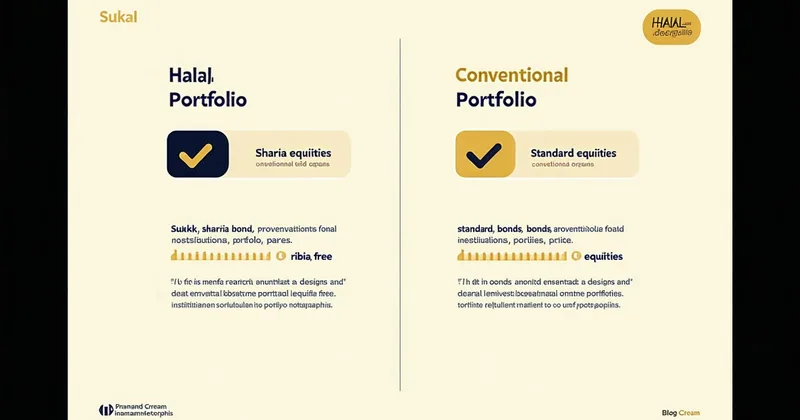
Halal investing and conventional investing start from different premises. One applies ethical and jurisprudential filters to the investment universe. The other does not. The practical effect on portfolio construction — sector weights, debt levels, return profiles — is more nuanced than "halal = fewer options = lower returns". This article examines what actually differs.
What Sharia screening removes from the universe
The most obvious exclusions are sector-based: alcohol, tobacco, pork, gambling, conventional banking and insurance, weapons, and adult entertainment. For a portfolio benchmarked against the FTSE All-World or MSCI World, these exclusions primarily affect the financial sector (conventional banks and insurance are a large component of most global equity indices) and, to a lesser extent, consumer staples (alcohol and tobacco companies are historically significant FTSE 100 constituents).
Financial sector exclusion is material. In the MSCI World index, financials typically represent 15–20% of market capitalisation. A Sharia-screened portfolio that excludes conventional banks and insurance companies is structurally underweight financials and must overweight other sectors to compensate — typically technology, healthcare, and industrial companies.
Debt ratio screening: more than sector exclusion
Beyond sector exclusion, Sharia screening applies a leverage filter: companies with interest-bearing debt exceeding 33% of market capitalisation are excluded. This filter has a significant and often underappreciated effect on portfolio composition. Highly leveraged companies — including many utilities, REITs, and some consumer companies — are excluded regardless of their sector.
The practical consequence is that Sharia-screened portfolios tend to hold companies with stronger balance sheets — less debt, more equity-financed growth. In periods of rising interest rates, highly leveraged companies tend to underperform as their debt-service costs rise. A Sharia-screened portfolio's structural underweight in such companies can provide some resilience in rising-rate environments.
Return comparison: the evidence
There is extensive academic and industry research on the performance of Islamic equity indices versus conventional equivalents. The consensus, broadly stated, is that over long periods the difference in returns is small and not consistently in either direction — Sharia-screened portfolios have outperformed in some periods (particularly during the 2008 financial crisis, when financial sector exclusion was an advantage) and underperformed in others (in periods of strong financial sector performance, such as the early 2020s recovery).
The MSCI World Islamic index, the S&P 500 Shariah index, and the Dow Jones Islamic Market index have each shown this pattern over their histories. The tracking error relative to conventional equivalents is meaningful — you are investing in a different portfolio — but the long-run return differential has not been systematically large in either direction.
Past performance data from these indices does not guarantee future results. The composition of Sharia-screened portfolios and their performance relative to conventional indices will change as the global economy evolves.
Sector weighting differences
A Sharia-screened global equity portfolio typically has material differences from a conventional global equity index:
- Overweight: technology (large tech companies typically have low debt and clean revenue), healthcare (similarly), and industrials
- Underweight: financials (banks and insurers excluded), utilities (high leverage typical), REITs (interest-bearing debt structure typical)
- Variable: consumer discretionary and consumer staples (depends on specific holdings and revenue screen)
These are structural weights driven by the screening criteria, not active allocation decisions. They mean your portfolio will behave differently from a conventional global tracker in certain market conditions — that is not a flaw; it is the consequence of the ethical and jurisprudential framework you have chosen to apply.
What halal investing does not sacrifice
Diversification, long-term compound growth, currency diversification through global equities, and the tax efficiency of the ISA wrapper are all fully available within a Sharia-screened portfolio. The sacrifice — such as it is — is the exclusion of certain sectors and high-leverage companies. For an investor whose conviction leads them to avoid those sectors regardless, the sacrifice is zero.
This article is for informational purposes only. Past performance is not a reliable indicator of future results. Capital at risk. Sharia compliance assessed by Wealth8's independent Sharia Supervisory Board; compliance does not guarantee investment returns.